


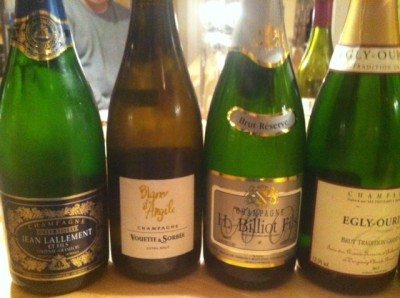
 The last few years taught me that Champagne is wine, not just bottled fireworks poised to explode on special occasions. Champagne’s food and aperitif friendliness are more interesting to me now than at any other time during my twenty seven year wine zag. I used to zag around Champagne while others zigged straight at it. I wanted to love Champagne, but couldn’t. Bubbles distracted my ability to detect flavors while effervescence made it challenging for wines to linger comfortably in my mouth. I deemed myself a wine misfit.
Champagne prices were always relatively high and it never seemed to make sense investing time to develop a deeper understanding of the region and its wine. After all, the whole affair was about a luxury beverage designed for something other than regular consumption. Right? Bordeaux felt entirely more accessible when I was picking spots to invest my very limited wine budget back in the mid-eighties. Knowing that I was getting Montrose, Leoville Las Cases, or Haut Brion grown and made product when I bought their wines was subconsciously important to me. The big Champagne brands that bought and blended fruit to achieve house and label styles like Moet & Chandon, Veuve Clicquot, and Perrier Jouet, as examples, felt predictably manipulated and overproduced. They achieved luxurious consistency and uniformity while stripping high volume purchased fruit of nuance and terroir.
It’s been a crazy prejudice, especially since the occasional opportunities to drink these wines were always enjoyable on some level. Somewhere along the way, my palate redeemed itself by shedding its unappreciative Champagne bias.
I now recognize my increasing exposure to Grower Champagnes, wines made by the same people that grow the fruit, helped motivate me to drink and learn more about Champagne
So I was excited to have our Boston blind tasting group take on a dozen grower Champagnes; eleven non vintage wines and one 2006 vintage bottling. I was ready to find a handful of wines that I could stock for regular drinking from the following:
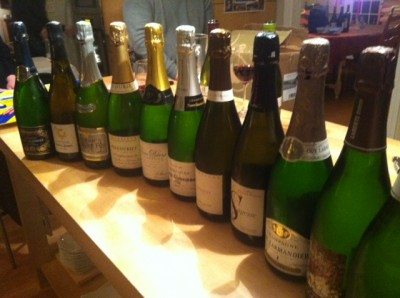
Egly-Ouriet Brut Tradition Grand Cru $75 ****
Vouette et Sorbee Blanc d’Argile $100 ***
Pierre Peters Blanc de Blancs Grand Cru Reserve $65 ****1/2
Guy Larmandier Vertus Premier Cru $50 ***
Franck Pascal Sagesse Brut Nature $60 ***1/2
Rene Geoffroy Brut Expression $45 ***
Jacques Lassaigne Le Cotet Brut Blanc de Blancs $70 **
Laherte Freres Brut Nature Blanc de Blancs $35 **
Jean Lallement Brut Cuvee Reserve $60 ***
Pierre Gimonnet 1er Cru Blanc de Blancs $45 ****
H. Billiot Brut Reserve $50 ****
2006 Jose Dhondt Blanc de Blancs $50 ***
 I asked Rich Auffrey, who writes at The Passionate Foodie, to share some background on Champagne with the group, whatever he wanted, since he spent some focused tasting time in Champagne this year. Rich mentioned that 90% of the vineyards are divided into about 280,000 plots that are farmed by 15,000 independent growers. Most of them don’t produce wine and just sell their grapes. About 2/3 of all the grapes are bought by large Champagne houses.
Growers known as Recoitant-Manipulants (look for RM on the bottle), grow and harvest their own fruit and make their own wine. Rich shared some statistics underscoring the fact that most Grower Champagne stays in France. Even though of all the Champagne imported into the United States only 3.7% is Grower Champagne, it is a rapidly growing segment of this French bubbly export market.
I like them because of the unique profiles. Grower Champagnes are more reflective of their terroir, not as consistent from year to year as wines made by the big Houses, and offer flavors belonging to their vineyards of origin. To me, they are wines born out of the idiosyncratic struggles and advantages attached to their native patch of vineyard land. Maybe that’s why there was no clear favorite and why so many of the wines we tasted blind offered something uniquely interesting. The Billiot, Gimonnet, and Peters all shared the same amount of votes and tied for top wines. Our blind tasting group had never produced a tie like this before. Only one wine, the Laherte Freres (unfortunately the cheapest) received zero votes. Every other wine scored close.
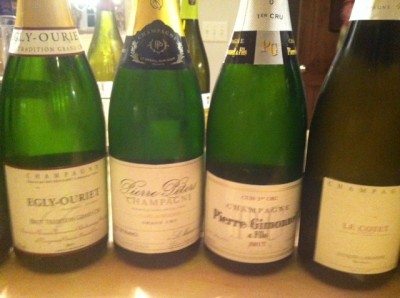 The Egly Ouriet showed mushrooms, yeast, smoke, and dark color that made it stand out in this lineup with the Pascal for its distinctively oxidized notes and creamy mid-palate (a highly controversial wine, but my second favorite of the night). Peters was my favorite for its brightness, sweet fruit and floral perfumed nose, and peach flavor.
The group’s consensus was that every wine offered something enjoyable; not an unattractive wine in the bunch. The most expensive $100 Vouette et Sorbee, with its highly expressive baked apple nose and clean fresh flavors had fewer votes than the $45 Gimonnet, the $50 Billiot, and the $45 Geoffroy. But each one had its own endearing style, and our many different palates leaned toward their own comfortable landing zones. Cream, lemon, apple, yeast, crisp, tight bubbles, elegant, caramel, quince, summer fruit, tangerine, mushroom, acidity, etc. The rainbow of characteristics was colorful and varied, each wine lining up neatly in it own appropriate spot on the spectrum.
There is a lot to like about Grower Champagnes; starting with their relatively low prices and ending with varied style and unique terroir. They are authentic wines that are finally making it fun for me to drink and learn more about Champagne. You won’t go wrong with any of these wines, but if you drink all of them side by side like we did, you will find your preferred style.
Note: Thanks to Matteo at Wine Bottega for helping me source most of these wines with ease.